
Harmful ingredients
Oxybenzone (Benzophenone-3): The Dark Side of a Popular Sunscreen Ingredient
Oxybenzone (also called Benzophenone-3 or BP-3) is one of the most commonly used chemical sunscreen ingredients worldwide. It absorbs ultraviolet (UV) radiation and helps prevent sunburn, but in recent years, scientific and regulatory bodies—including the U.S. Centers for Disease Control and Prevention (CDC) and the U.S. Food and Drug Administration (FDA)—have raised questions about how much of it enters the body and whether it may affect human health or the environment.
This article summarizes what the latest research shows about oxybenzone exposure and its potential side effects, using data from large national surveys and human clinical trials, followed by a review of key health findings explained in simple terms.
Oxybenzone found in 96 % of Americans
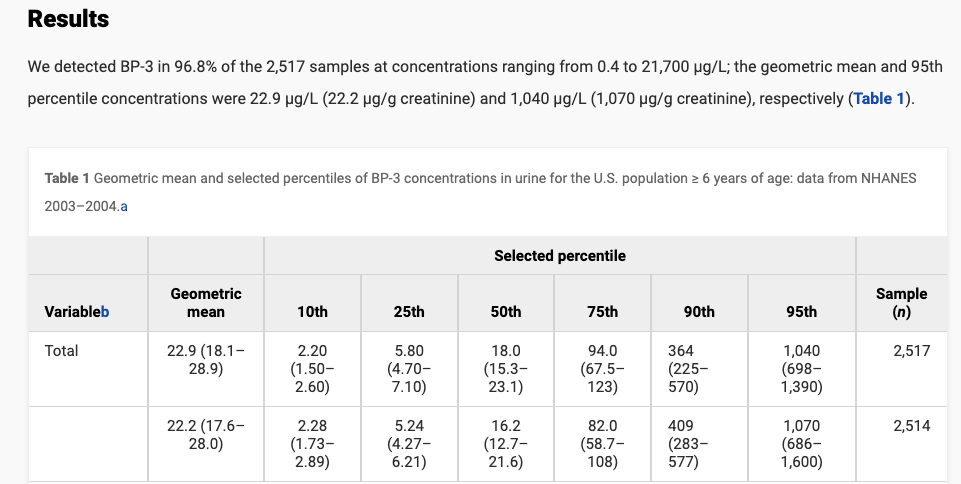
In the early 2000s, German scientists found traces of oxybenzone in human urine and plasma after sunscreen use. Therefore, in 2008, the U.S. CDC’s NHANES program, urine samples from 2,517 participants were analyzed for oxybenzone.
Over 96 % of Americans — including children — had measurable oxybenzone in their bodies.
RESULT SNAPSHOT:
That discovery transformed oxybenzone from a photoprotection hero into a compound under toxicological scrutiny.
Chemical Sunscreens are Absorb into the Blood
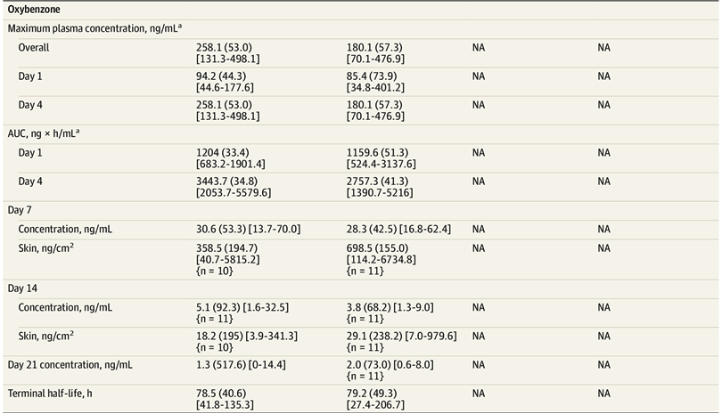
In 2019 and 2020, the FDA conducted two landmark clinical trials (Matta et al., JAMA 2019; JAMA 2020) known as Maximal Use Trials (MUsT). These studies were designed to test whether active sunscreen ingredients, including oxybenzone, are absorbed into the bloodstream when applied according to real-world label instructions.
Study details (Matta et al., 2020):
Participants: 48 healthy adults.
Application: 2 mg/cm² of sunscreen over 75% of body surface area, four times daily for four consecutive days.
Blood testing: 34 samples collected over 21 days.
Results: All six tested chemical filters (oxybenzone, avobenzone, octocrylene, homosalate, octisalate, and octinoxate) were absorbed through the skin.
Oxybenzone showed the highest absorption:
Maximum blood concentration ≈ 258 ng/mL — over 400 times higher than the FDA’s threshold (0.5 ng/mL) for requiring additional safety studies.
Oxybenzone and homosalate remained in the bloodstream up to three weeks after the last application.
As a result, the FDA’s 2020 proposed sunscreen rule stated that oxybenzone and most other chemical UV filters cannot currently be classified as “GRASE” (Generally Recognized As Safe and Effective) until more absorption, toxicology, and long-term safety data are submitted by manufacturers.
STUDY RESULT SNAPSHOT
Low Testosterone in Males
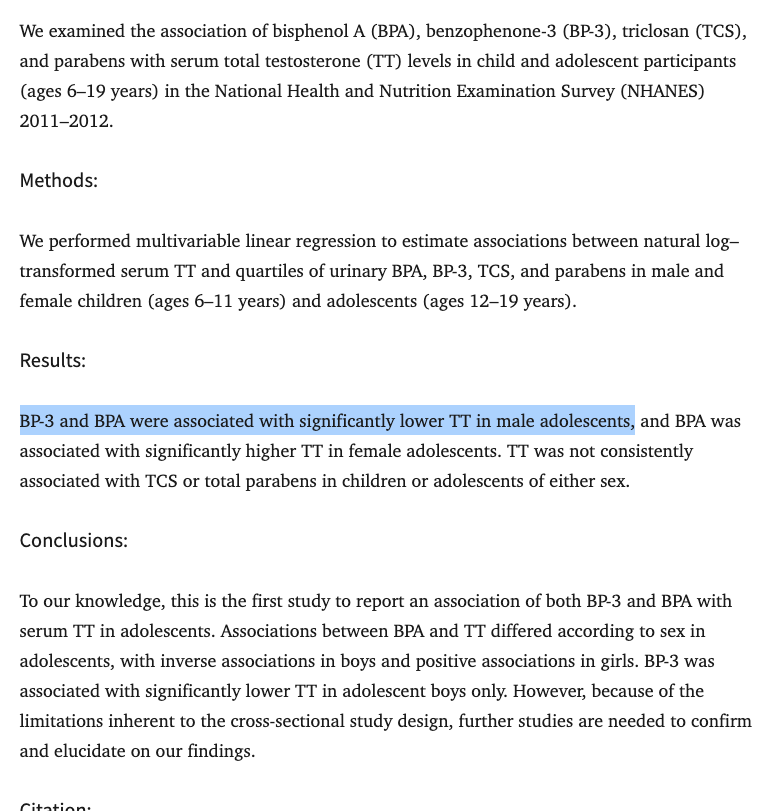
Study: Scinicariello & Buser (2016) — “Urinary benzophenone-3 concentration and serum testosterone levels in U.S. males”
Details: Among 588 male adolescents/adults, high urinary BP-3 had significantly lower total testosterone.
Comment: Suggests a potential anti-androgenic effect in males, but limited by cross-sectional design.
Snapshot:
Menstrual Irregularities in Females
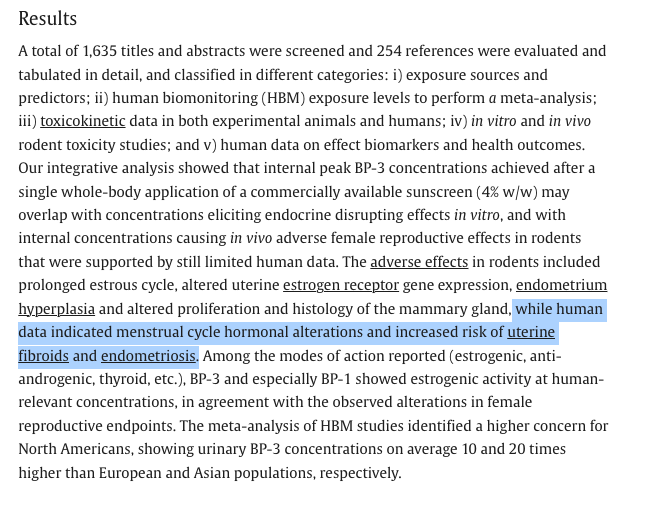
Study: Mustieles et al. (2023) review – “Benzophenone-3: comprehensive review of the toxicological and human evidence”
Details: The review summarises human evidence suggesting menstrual cycle hormonal alterations and increased risk of uterine fibroids and endometriosis associated with BP-3 exposure.
Link: https://www.sciencedirect.com/science/article/pii/S0160412023000120
Snapshot:
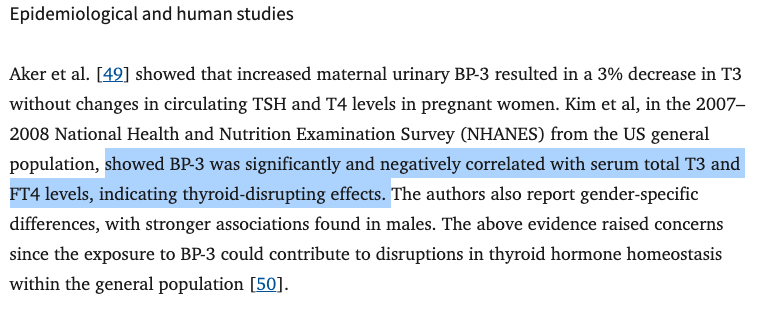
Thyroid Irregularities in Pregnant women
Study: Aker et al. (2018) – “Urinary BP-3 and thyroid hormones in pregnant women” among others
Details: Among 439 pregnant women, increases in urinary BP-3 were associated with a ~3% decrease in free triiodothyronine (T3); no consistent changes in TSH or T4 were found.
Snapshot
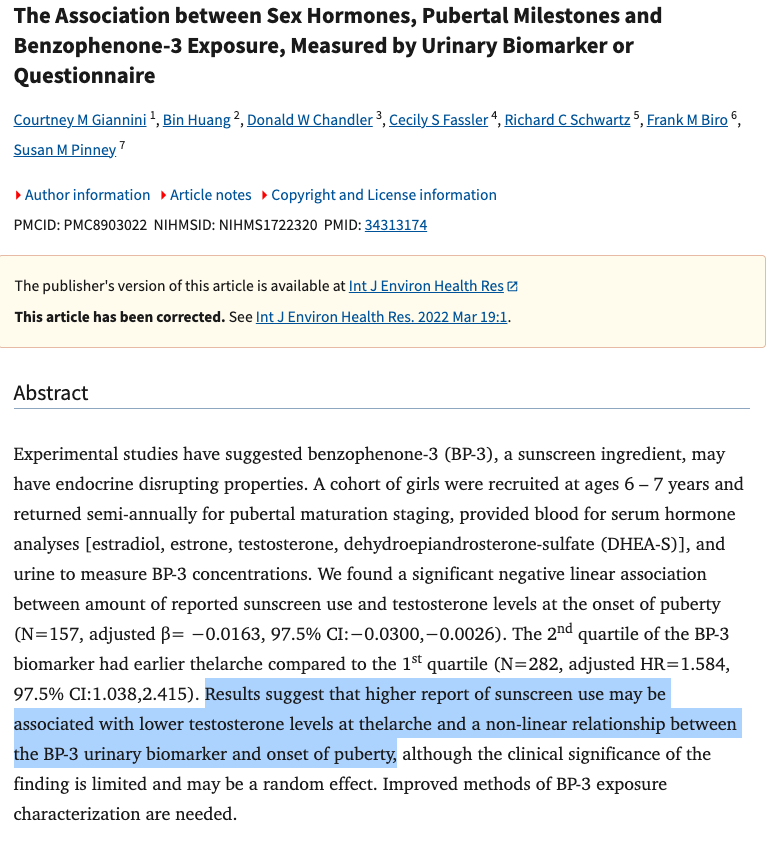
Early (or Altered) Puberty in Girls
Study: The Association between Sex Hormones, Pubertal Milestones and Urinary Biomarkers (2021)
Details: In a cohort (N=157) of girls, reported higher sunscreen/ BP-3 biomarker use was significantly associated with lower testosterone levels at onset of breast development and earlier thelarche.Comment: Indicates possible disruption of pubertal timing in females related to BP-3 exposure. However sample size is modest and findings need confirmation.
Snapshot
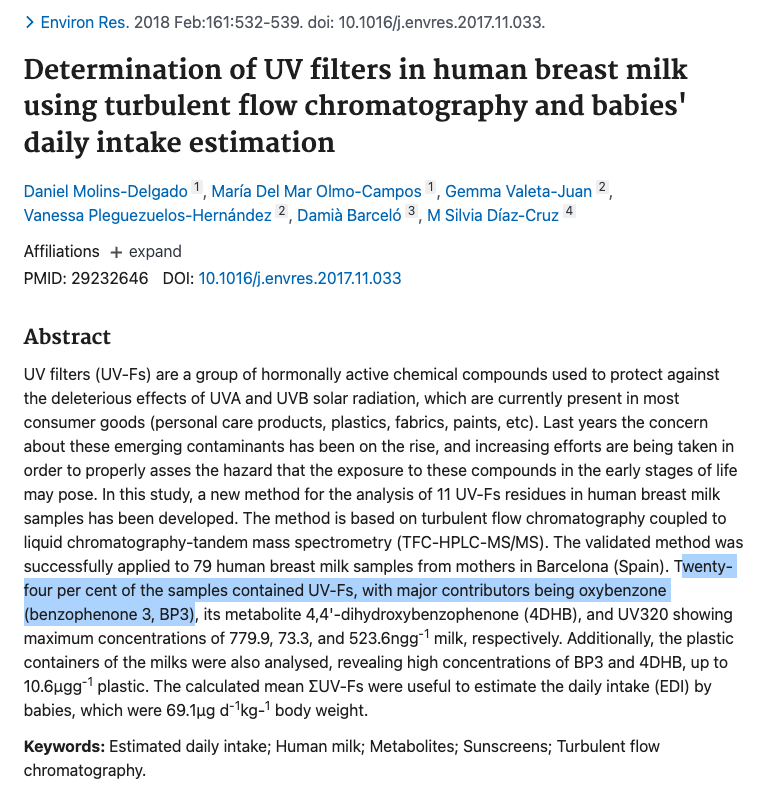
Found in Breast Milk
Study: “Determination of UV filters in human breast milk using turbulent flow …” (2018)
Details: In 79 human breast-milk samples from Barcelona mothers, multiple UV filters including BP-3 were detected.
Comment: Demonstrates that BP-3 can be transferred from mother to infant via breast milk. It does not prove harm to the infant, but it establishes exposure.
Snapshot:
Better & Safer Alternatives
Choose sunscreens that use these modern, reef-safe filters:
Safe Ingredient | What It Does |
|---|---|
Zinc Oxide | Reflects UV rays, gentle for sensitive skin |
Titanium Dioxide | Works like a physical shield |
Tinosorb S / M | Modern chemical filters, long-lasting & safe |
Uvinul A Plus / T 150 | Stable, non-hormone-active filters |
Mexoryl SX / XL | Scientifically proven, very safe for daily use |
Conclusion
These studies point to possible side-effects of oxybenzone including endocrine disruption (male testosterone, female hormones, thyroid, puberty) and infant exposure via breast milk. However, none of these establish definitive causation.
Since safer sunscreen options are now available, it is best to avoid formulations containing older chemical filters such as oxybenzone (benzophenone-3), octinoxate, avobenzone, and octocrylene. These ingredients have shown systemic absorption and potential endocrine-disrupting effects in human and laboratory studies.
Instead, choose sunscreens that carry the green safety badge by Dermatocare, which indicates that every ingredient has been individually screened for safety and efficacy. Opting for these formulations helps you and your family stay protected from harmful UV rays without compromising long-term health or environmental safety.
I hope this article helps you make a more informed and confident sunscreen choice for yourself and your loved ones.