Grey Hair
How to Use Henna and Indigo for Natural Black Hair: 2-Step Guide
Natural black hair from plants is a two-step process: henna first (it gives an orange-red base), then indigo on top (it turns that base to brown and then black). Indigo alone usually gives a blue-green tint on grey hair. Patch test first, even with pure henna and indigo, because allergy to both is uncommon but documented. See a dermatologist if you get itching, swelling, blistering or oozing on the scalp, face or neck.
Why henna and indigo need two steps
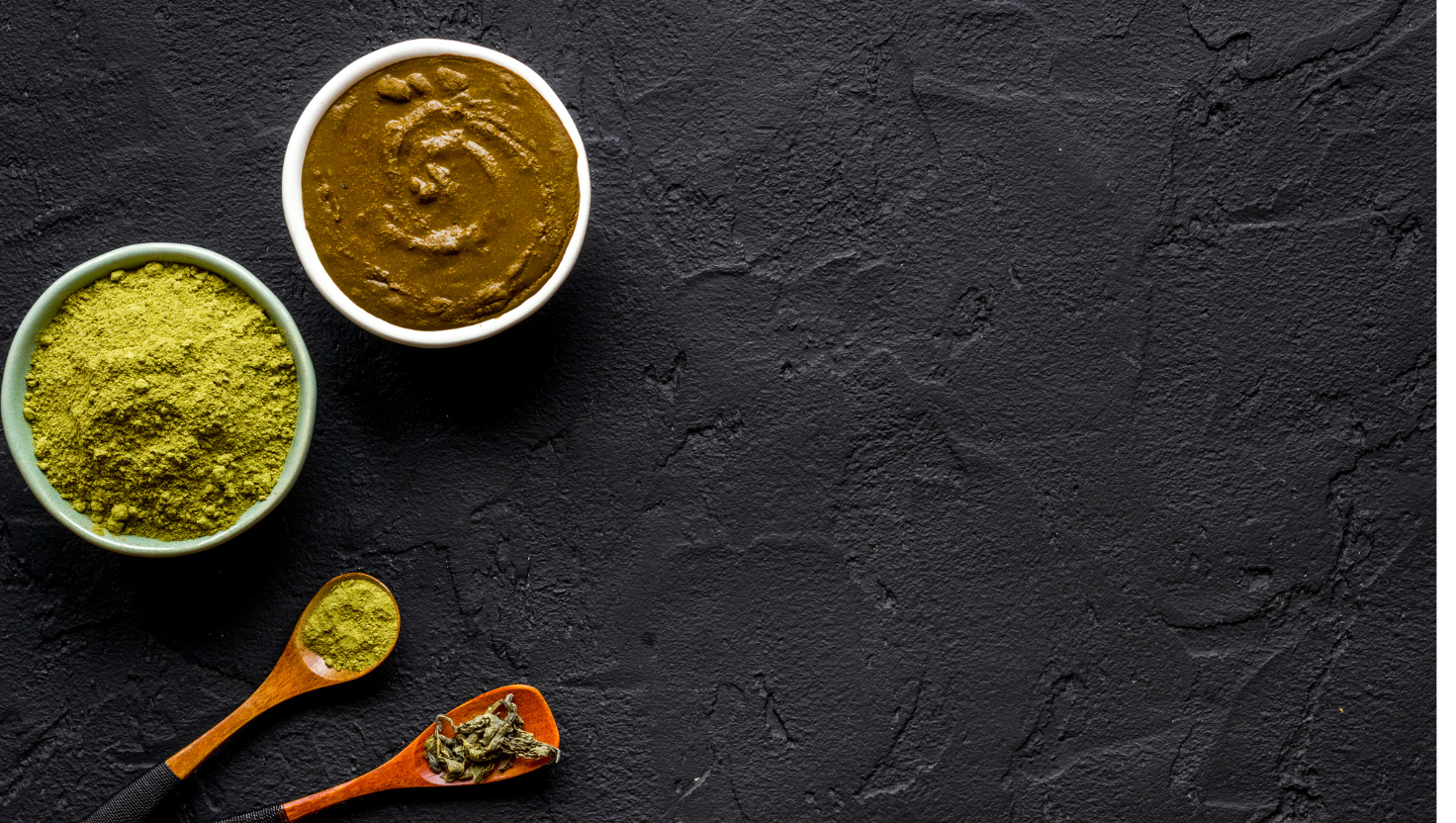
Henna comes from the leaves of Lawsonia inermis. Its dye molecule is lawsone, which binds to the keratin protein in hair and stains it orange to red. It works on the surface layers and builds up with repeat use 1, 3.
Indigo powder comes from Indigofera tinctoria. Used alone it gives a blue tint that looks dull or greenish on grey or light hair. Layered over a henna base, the orange and blue combine to give deep brown to jet black.
That is why the correct order matters: henna, rinse, then indigo. Mixing them into one paste or reversing the order usually gives weaker, uneven or greenish results.
Before you start: check what you are buying
Read the label and buy pure powder. Henna should be plain Lawsonia inermis powder, and indigo should be plain Indigofera tinctoria leaf powder. Avoid products that promise black in a single step or list unnamed "natural dyes".
Why this matters:
"Black henna" does not occur in nature. The dark colour is usually created by adding PPD, a coal-tar dye
A 2025 laboratory analysis of henna products sold in Poland found that up to 36% of samples contained PPD (1% to 9%), and only three of five of these were labelled correctly.
PPD reactions can be severe and can leave a person sensitised to permanent hair dyes for life
In the US, the FDA states that henna is approved only as a hair dye, not for direct skin application, and that PPD is not permitted in products applied to skin.
Indigo has its own regulatory review.
The EU's Scientific Committee on Consumer Safety (SCCS) concluded in 2020 that Indigofera tinctoria can be considered safe (its wording) in non-oxidative hair colouring products at up to 25% on the head, while noting that a weak skin sensitisation potential cannot be excluded.
Step 0: Patch test (do this 48 hours before)
Mix a small amount of the henna paste (and separately the indigo paste) as you plan to use it.
Apply a small dab to a discreet area, such as behind the ear or the inner forearm.
Leave it for the time on the pack, rinse, and watch the area for at least 48 hours. Delayed allergic reactions can appear after a day or two.
Stop and do not use the product if you see redness, itching, swelling or blisters.
Repeat the test before each new batch or brand.
Patch testing is advised before hair colour of any kind, and even a colour you have used before can trigger a new reaction
Allergy to pure henna is uncommon, but a 2026 systematic review found patch-test-confirmed cases, mostly in women, though children were also affected.
Step 1: Apply henna
Mix pure henna powder with a warm, mildly acidic liquid (for example diluted lemon juice or tea) to a thick yogurt-like paste. Let it rest so the dye releases.
Apply on clean, dry or slightly damp hair, section by section, from roots to ends. Protect the skin along the hairline with a thin layer of oil.
Cover with a plastic cap and leave on for the time given on your product's pack, commonly a few hours.
Rinse with plain water until it runs clear. Do not shampoo yet.
Step 2: Apply indigo
Mix indigo powder with warm water into a smooth paste. Apply it soon after mixing and do not let it sit, because indigo loses strength quickly.
Apply over the henna-dyed hair, section by section. Wear gloves, as indigo stains skin and nails.
Cover and leave on for the time given on the pack, commonly one to two hours.
Rinse well with plain water.
Wait a day before shampooing so the colour can settle and deepen.
Colour deepens over the first two days as indigo oxidises in air.
Grey and white hair usually takes more than one round to reach true black.
Who should not use henna
G6PD deficiency. Lawsone can cause oxidative damage to red blood cells. In laboratory tests, blood from G6PD-deficient people formed much more methaemoglobin when exposed to lawsone than normal blood
Newborns and infants. In a Kuwait hospital series, 15 G6PD-deficient male newborns were admitted with haemolysis, anaemia and high bilirubin a few days after henna was applied to their bodies. Do not apply henna to babies.
Broken, inflamed or infected scalp skin. Wait until it heals and ask a dermatologist.
Aftercare and good habits
Use gloves, and keep the paste away from eyes. Indigo powder is a mild eye irritant in animal studies reviewed by the SCCS.
Use a mild shampoo and a conditioner or oil after the first wash. Henna can feel drying.
Keep it to a schedule your hair tolerates. Regrowth touch-ups are usually done at the roots only.
Do not follow with chemical bleach or perm treatments on the same hair without professional advice, as results can be unpredictable.
When to see a doctor
See a dermatologist promptly if you develop swelling of the face or eyelids, blistering, oozing, or intense itching after colouring. Seek urgent care for breathing difficulty. If a baby or a G6PD-deficient person was exposed to henna and becomes pale, unusually sleepy, jaundiced or has dark urine, get medical help the same day.
Frequently asked questions
It usually works better in two steps. Henna first gives the orange-red base, and indigo over it gives brown to black. A single mixed paste tends to give a weaker, less even shade, especially on grey hair.
References
Zinkham WH, Oski FA. Henna: a potential cause of oxidative hemolysis and neonatal hyperbilirubinemia. Pediatrics 1996;97(5):707-709. PMID: 8628611.
Kandil HH, al-Ghanem MM, Sarwat MA, al-Thallab FS. Henna (Lawsonia inermis Linn.) inducing haemolysis among G6PD-deficient newborns. A new clinical observation. Ann Trop Paediatr 1996;16(4):287-291. PMID: 8985525. doi:10.1080/02724936.1996.11747840.
Sienkiewicz-Szłapka E, Janysz A, Wróbel MH. Quantification of lawsone and p-phenylenediamine in natural henna products for hair colouring available in Poland. Contact Dermatitis 2025;92(4):261-272. PMID: 39756814. doi:10.1111/cod.14739.
Wolf R, Marcos B, Orion E, Matz H. The myth of black henna. Skinmed 2006;5(1):39. PMID: 16522983. doi:10.1111/j.1540-9740.2006.04633.x.
Ramírez-Andreo A, Hernández-Gil A, Brufau C, et al. Allergic contact dermatitis to temporary henna tattoos. Actas Dermosifiliogr 2007;98(2):91-95. PMID: 17397594.
Scientific Committee on Consumer Safety (SCCS). Opinion on hair dye Indigofera tinctoria (C170), Submission III. SCCS/1615/20, final opinion adopted 3 April 2020. European Commission. https://health.ec.europa.eu/system/files/2021-11/sccs_o_237.pdf
U.S. Food and Drug Administration. Temporary Tattoos, Henna/Mehndi, and "Black Henna": Fact Sheet. https://www.fda.gov/cosmetics/cosmetic-products/temporary-tattoos-hennamehndi-and-black-henna-fact-sheet
U.S. Food and Drug Administration. Hair Dyes (patch test guidance for coal-tar hair dyes). https://www.fda.gov/cosmetics/cosmetic-products/hair-dyes
Nawaf AM, Joshi A, Nour-Eldin O. Acute allergic contact dermatitis due to para-phenylenediamine after temporary henna painting. J Dermatol 2003;30(11):797-800. PMID: 14684936.
Ben Yahia M, Korbi M, Belhadjali H, et al. Allergic contact dermatitis to pure henna: a systematic review. Contact Dermatitis 2026 (online ahead of print, 31 July 2026). PMID: 42535430. doi:10.1111/cod.70227.
Conclusion
Henna followed by indigo can give natural dark hair, but only when you use pure powders, patch test first, and avoid henna in G6PD deficiency and in babies. When in doubt, ask a dermatologist before you colour.
Not sure which routine fits your skin? Try our Routine Finder Tool →
Related reading: